
President Jason Linklater was invited to address Manitoba nurses attending the annual general meeting of the Manitoba Nurses Union. Below is a transcript of his address, held in April 2026 at the Fairmont Winnipeg.
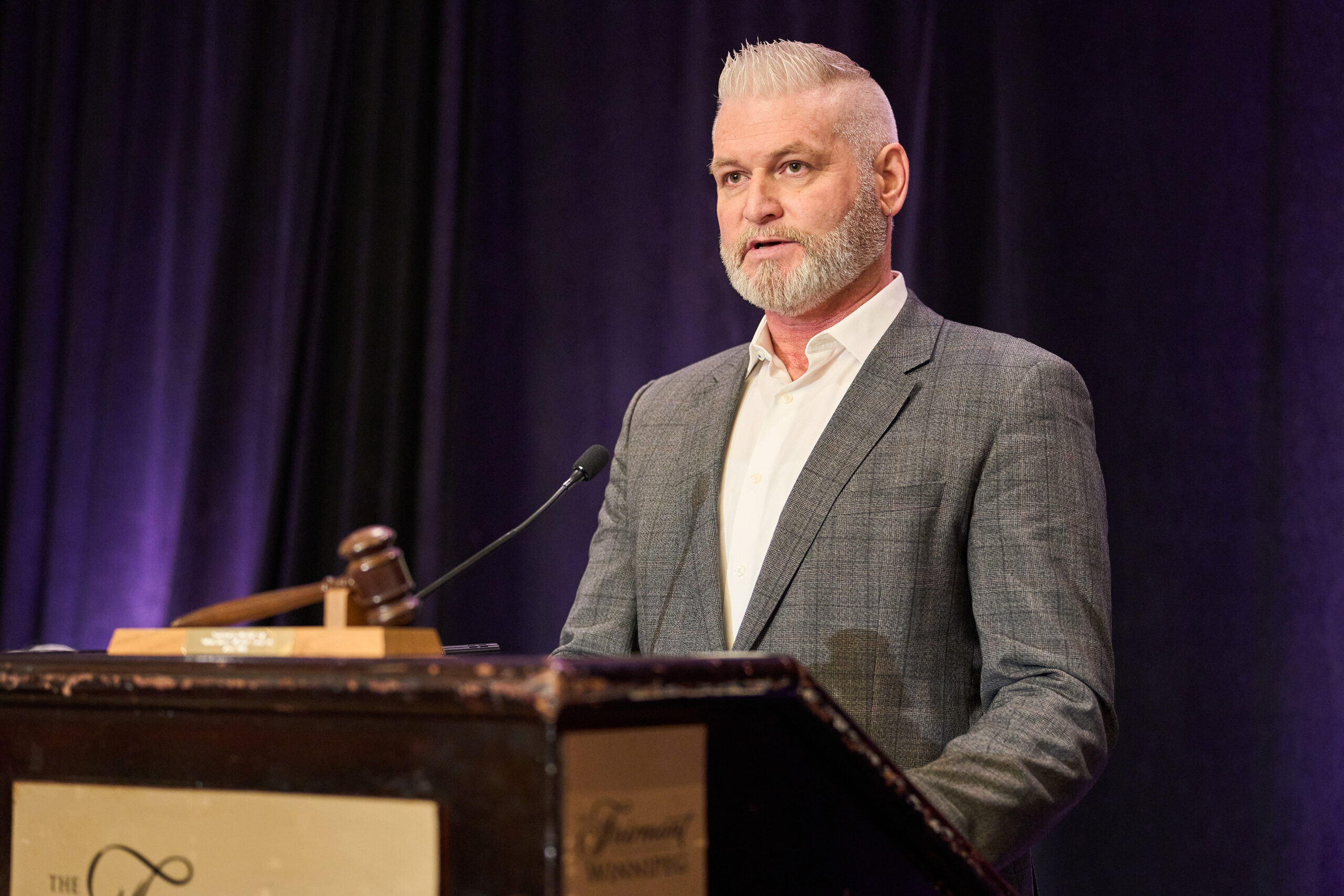
Photo credit: David Lipnowski.
Thank you to the membership of the Manitoba Nurses Union for having me here today. This is your AGM, your time, and the fact that you have carved out space for an allied health leader at this podium says something important about where our two organizations have arrived together.
MAHCP represents more than 7,500 allied health professionals across 50+ specialized disciplines in this province. But before all of that, I want to tell you who I am, in this room today.
My mother was a registered nurse. My father was a registered nurse. And before anyone asks: yes, more than 50 years ago, a man becoming a RN was uncommon enough that it said something real about who he was and what he valued. It shaped him. Whether he actually practised is a question our family still debates around the kitchen table, but the fact that he pursued and completed the training spoke to something in his character that I carry with me today.
My wife is a nurse. Thirty years in neonatology…And I can tell you from lived experience that nurses do not leave the job at the hospital door. Nurses bring it home and talk about it at dinner. Nurses process it out loud. Nurses shape the culture of every household they live in.
I say this because it matters to me: Nurses have shaped every part of my life. My values, my understanding of what patient care actually looks like up close, my sense of what the system owes the people who hold it together. I did not come to healthcare leadership just from a textbook. I came to it from a family of people who gave their working lives to it.
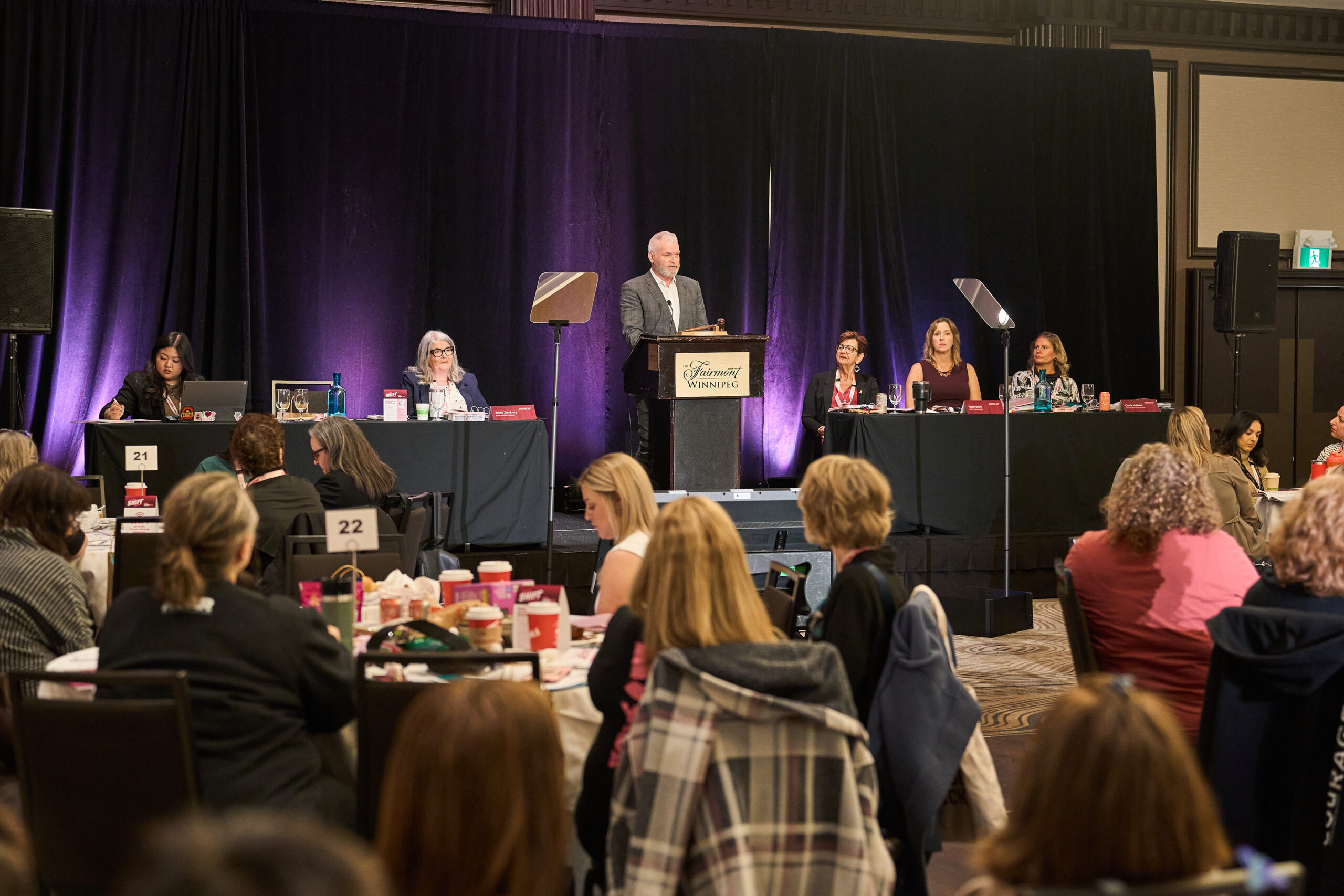
Photo credit: David Lipnowski.
A different relationship
I was asked to speak today about how, over the past two years, MAHCP and MNU have been working together in a way that is markedly different from the past. That is an honest description. It is also an understatement. For a long time, healthcare unions and associations in this province operated in parallel. Same hallways, same broken systems, same exhausted workers, but separate strategies and separate relationships with government. We occasionally ended up on the same side of an issue, but it was by coincidence more often than by design.
Much of that has changed. What Darlene (Jackson), MNU President, and I have built — and I want to credit her directly because leadership on this has been genuinely mutual — is a relationship grounded in a simple recognition: the issues that keep nurses up at night are the same issues that keep allied health professionals up at night. Mandatory overtime. Workplace violence. Chronic understaffing. Vacancy rates that make safe patient care impossible. A government that counts headlines instead of outcomes.
We work in the same environments. Your nurses and our respiratory therapists are side by side in the same ICUs. Your nurses and our paramedics hand off the same patients in the same emergency departments. Your nurses and our lab technologists depend on each other for the diagnostic information that determines whether a patient lives or dies. The idea that we would fight these battles separately is incoherent.
What this looks like in practice
Let me give you concrete examples, because I believe in evidence and specifics, not slogans.
When the Premier told Manitobans in December that long wait times would be fixed by the end of 2026, Darlene and I both pushed back in the same CBC article. Not because we coordinated that morning, but because we had already been having the same conversations for months. The public heard two separate organizations, representing tens of thousands of healthcare workers, arrive at the same conclusion independently. That is more powerful than any joint press release.
When the government directed health authorities to find 50 million in administrative savings, Darlene called it reminiscent of Brian Pallister’s 15 per cent cuts. I said the notion that there is fat to trim in health care is a myth. Different words. Same diagnosis. Same consequence for the people doing the work.
When interprovincial labour mobility became a federal talking point this spring, Darlene and I landed in the same place again: A province that underpays and overworks its healthcare workforce cannot afford to make it easier to leave without first making it worth staying.
And this month, MAHCP and MNU signed a joint letter to the employer signatories of the Health Employees Benefits Plan on the premium increases now affecting every member of both organizations. The benefit improvements that are now in place would not have happened without joint union pressure. The employers’ side raised concerns about employee affordability and then went silent the moment the government covered their share of the increased costs to the plan. Darlene and I asked one question: Was your concern for our members genuine, or did it disappear when your own costs were covered? No answer. But the improvements are real, and they only exist because unions acted together.
A new direction for health care advocacy
What Darlene and I are doing when we work together is not a partisan project. It is about holding every government, regardless of party, to a standard that the people delivering care have a right to demand. That is not a comfortable position to take with a government that considers itself friendly to labour. But comfort and accountability are not the same thing.
When the government told Manitobans they hired 4,054 net new healthcare workers, we did not applaud. MAHCP filed a Freedom of Information request. And what came back confirmed what our members already knew: Shared Health doesn’t have any workforce modelling for any allied health profession in Manitoba. No demand projections. No attrition forecasting. No capacity planning. Darlene has said publicly that when the government announces nursing hires, her members ask: where are they? That is not cynicism. It is the gap between what a press release says and what the nursing unit looks like at two in the morning.
Leadership means trading political comfort for member outcomes, even when the government in question continues to articulate the right commitments. That is the hardest call a union president makes. And in the relationship between MAHCP and MNU, both of our organizations have made that call repeatedly over the past two years.
Work that benefits everyone
In February, MAHCP filed an application in the Court of King’s Bench to compel the Province to enforce the Workplace Safety & Health Act. After two years of asking for legally required annual reports on workplace violence and safety committees, we did not receive the reports, and we’ve learned that health & safety representatives and committees which are required by law are in a shambles. Had this been a private company, they may have been fined or even shut down. For the province’s largest healthcare employer, there will be no consequences without legal pressure.
MNU grey-listed three of Winnipeg’s major hospitals for the same reasons. Two organizations. Different processes. Same conclusion about the same employer. That convergence is itself evidence. And it is stronger because it comes from two independent voices that cannot be dismissed as a single complaint.
I want to finish where I started: with nurses.
I have spent 30 years at HSC and now leading an organization that works alongside nurses in every facility in Manitoba. The health system does not function without nurses, allied health professionals, and physicians operating in concert. A cardiac surgeon can operate, but without a perfusionist running the heart lung machine, and a perioperative nurse facilitating flow through the surgery, the patient will simply not receive the life-saving procedure they need.
The federal bilateral funding underwriting allied health and nursing staffing is expiring. The province is counting on transfers to balance its books. What comes next for all of us is harder than what came before us. The work ahead requires us to hold a ‘friendly’ government (one that is nominally aligned to union values) to the same standard as we held our previous ‘unfriendly’ governments.
We have not build a relationship between our two unions because it was convenient. We built it because it is beneficial. And the work isn’t finished. The work ahead requires the same kind of leadership that got us here: leadership that is willing to be uncomfortable, that puts member outcomes ahead of political relationships, and that understands the difference between being visible and being effective. When governments come into power the dynamic and relationship must change; the outcomes for our members are not driven by the level of ‘friendliness’. They are driven by strategic analyses, organizational credibility, and non-partisan accountability.
MNU and MAHCP are standing together because the people we represent are already standing together every day. In every facility. In every shift. In every corner of this province. And what we are building together is the only thing that will make this system work the way Manitobans deserve. Held to the standard it claims to meet. No matter who is in government. And without apology.
-30-